How to keep score in baseball
Keeping score looks like a secret code, but it's really just a tidy shorthand for what happens on the field. This beginner's guide covers the basics, the position numbers, the common symbols, and a worked inning-by-inning example.
Scoring basics
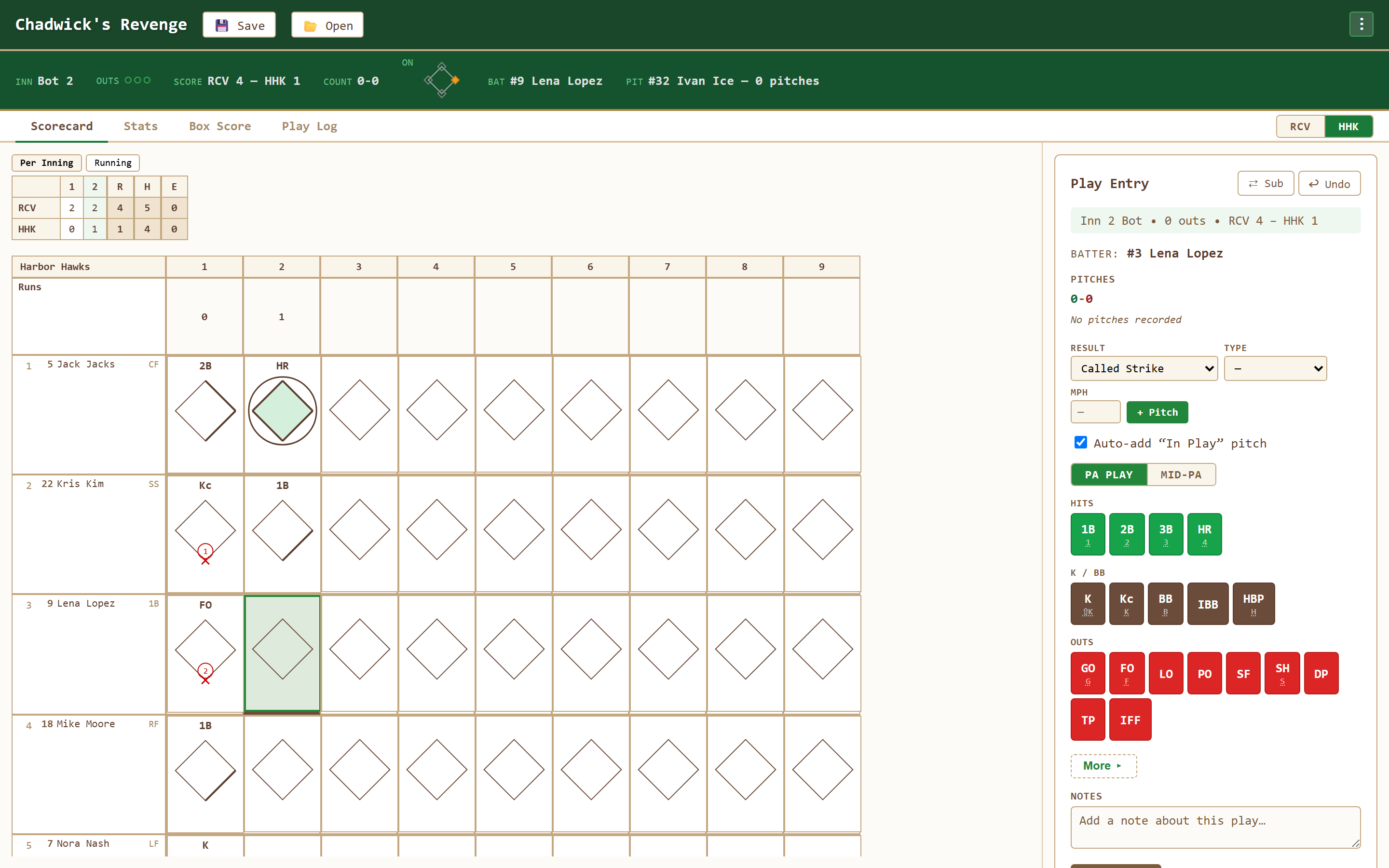
A scorecard has one row per batter in the lineup and one column per inning. Each cell contains a small diamond that represents the four bases. As a batter comes up, you record what they did in that inning's cell — and if they reach base, you trace their path around the diamond as they advance, all the way home if they score.
Three ideas do most of the work:
- Every fielder has a number (see the table below). Defensive plays are written with those numbers.
- The diamond in each cell is a map. Fill in the corner or trace the line a runner reaches — first, second, third, home.
- A filled-in diamond means a run scored. A clear, consistent scorecard lets anyone replay the game later.
Fielding position numbers
Defensive positions are numbered 1–9. These never change, and they're the backbone of scorekeeping notation.
| # | Position | # | Position |
|---|---|---|---|
| 1 | Pitcher (P) | 6 | Shortstop (SS) |
| 2 | Catcher (C) | 7 | Left Field (LF) |
| 3 | First Base (1B) | 8 | Center Field (CF) |
| 4 | Second Base (2B) | 9 | Right Field (RF) |
| 5 | Third Base (3B) |
So a ground ball fielded by the shortstop and thrown to first base for the out is written 6-3. A fly ball caught by the center fielder is F8.
Common symbols and notation
Here are the marks you'll use most. Chadwick's Revenge places these for you, but knowing them makes any scorecard readable.
| Symbol | Meaning |
|---|---|
| 1B | Single |
| 2B | Double |
| 3B | Triple |
| HR | Home run |
| BB | Base on balls (walk) |
| HBP | Hit by pitch |
| K | Strikeout (swinging) |
| Kc / ˉK | Called strikeout (looking) |
| F7 | Fly out (here, to left field) |
| 6-3 | Ground out, shortstop to first |
| FC | Fielder's choice |
| E6 | Reached on error (here, by the shortstop) |
| SB / CS | Stolen base / caught stealing |
| SF / SH | Sacrifice fly / sacrifice bunt |
| DP | Double play |
| WP / PB | Wild pitch / passed ball |
An inning, step by step
Imagine the top of the first. Here's how four batters might look on the card:
- Batter 1 lines a single to right. Write
1Band shade the path to first base. - Batter 2 strikes out swinging. Write
Kand mark the first out. - Batter 3 hits a double; the runner from first comes around to score. Write
2Bfor batter 3, extend batter 1's path all the way home, and fill in batter 1's diamond to show the run. - Batter 4 grounds out, shortstop to first:
6-3, the second out. Batter 3 holds at second.
At the end of the inning you can read the whole story off the card: one run, one hit left on base, and exactly who did what.
How Chadwick's Revenge helps
You can learn all of this on paper — but the app makes it painless while you're still learning:
- It writes the symbols for you. Tap what happened and the correct notation appears in the right cell.
- It does the math. Batting averages, RBIs, earned runs, and the box score are computed automatically.
- It's shareable and printable. Print your scorecard or download a PDF when the game ends.
- It works anywhere. Any tablet, phone, or laptop, online or off — free, with no install.
Scorekeeping questions
What do the numbers 1–9 mean on a scorecard?
They're the defensive positions: 1 is the pitcher, 2 the catcher, 3–5 the infield corners and second base, 6 the shortstop, and 7–9 the outfield from left to right. Plays are written using those numbers, like 6-3 for shortstop to first.
Do I have to memorize the symbols?
No. In Chadwick's Revenge you tap what happened and the app fills in the correct symbol and runner path — a great way to learn by watching.
Is this the same for softball?
Mostly, yes — the notation is shared. See the softball scorekeeper to set up a softball game.
Learn by doing
The fastest way to learn scorekeeping is to score a game. Open Chadwick's Revenge and let it place the symbols while you follow along — free and in your browser.
Open the ScorekeeperWorked examples for the tricky plays
Fielder’s choice: FC is not a hit
Runner on first, no outs. The batter grounds to short; the shortstop throws to second for the force and the batter reaches first. Mark the batter FC, record the runner’s out as 6-4, and leave the batter on first. The batter has an at-bat but no hit. If the relay to first also retires the batter, record the double play and both outs instead.
Sacrifice fly: the out and the run both matter
Runner on third, one out. The batter flies to center, the catch is made, and the runner tags and scores. Mark SF8, record the second out, and complete the runner’s diamond. Credit the batter an RBI and a sacrifice fly, not an at-bat. A fly out with no run scored is simply F8; advancing a runner from second to third alone does not make it a sacrifice fly.
Dropped third strike: a strikeout can still put a runner on
In rules that allow an uncaught-third-strike advance, with first base empty or two outs, the batter may try for first. If a swinging third strike gets away and the batter reaches safely, keep the strikeout and record the advance on WP or PB as appropriate. Do not credit a hit or a walk. If the catcher recovers and throws the batter out at first, record the strikeout and 2-3 putout sequence. Check your division’s rule before allowing the advance; youth and softball variations matter.
Separate the batter’s result from later runner movement
A single followed by a stolen base remains a single. Put 1B in the batter’s cell, draw home-to-first, then extend first-to-second with SB when the steal happens. A later wild pitch is WP, not another hit. Use an error only when your scoring judgment supports it, not whenever a play looks untidy.
A field-side notation cheat sheet
Download the free notation cheat sheet (PDF)
One page of position numbers, common marks, and the decisions behind FC, SF, and an uncaught third strike. Keep it beside a blank scorecard, or use it while learning the editable digital card. No email or account required.
For a full inning walkthrough, use the beginner’s guide; for the complete vocabulary, use the symbols reference.