Baseball scorecard symbols, fully explained
A complete reference for every mark you'll see on a baseball scorecard — position numbers, hits, walks, strikeouts, outs, errors, and base-running notation. Bookmark this page, or let Chadwick's Revenge write the symbols for you.
Fielding position numbers (1–9)
Every defensive position has a fixed number, and it never changes. Plays are written using these numbers rather than position names — a ground ball to the shortstop, thrown to first base, is 6-3.
| # | Position | # | Position |
|---|---|---|---|
| 1 | Pitcher (P) | 6 | Shortstop (SS) |
| 2 | Catcher (C) | 7 | Left Field (LF) |
| 3 | First Base (1B) | 8 | Center Field (CF) |
| 4 | Second Base (2B) | 9 | Right Field (RF) |
| 5 | Third Base (3B) |
Hits and times on base
| Symbol | Meaning |
|---|---|
| 1B | Single |
| 2B | Double |
| 3B | Triple |
| HR | Home run |
| BB | Base on balls (walk) |
| IBB | Intentional walk |
| HBP | Hit by pitch |
| E6 | Reached on error (number identifies the fielder — here, the shortstop) |
| FC | Fielder's choice |
| CI | Catcher's interference |
Strikeouts and the backwards K
A strikeout is always K — but which direction it faces matters:
| Symbol | Meaning |
|---|---|
| K | Strikeout swinging |
| Ǩ / backwards K | Strikeout looking — the batter took a called third strike without swinging |
| DTS / K+WP | Dropped third strike, batter reaches base |
Outs
| Symbol | Meaning |
|---|---|
| 6-3 | Ground out, shortstop to first base |
| F8 | Fly out, caught by the center fielder |
| L4 | Line out, caught by the second baseman |
| P2 | Pop out, caught by the catcher |
| IFF | Infield fly (batter is automatically out) |
| SF | Sacrifice fly |
| SH / SAC | Sacrifice bunt |
| DP | Double play |
| TP | Triple play |
Base running & mid-play events
| Symbol | Meaning |
|---|---|
| SB | Stolen base |
| CS | Caught stealing |
| PO | Picked off |
| WP | Wild pitch |
| PB | Passed ball |
| BK | Balk |
| DI | Defensive indifference (uncontested advance) |
| OBS | Obstruction |
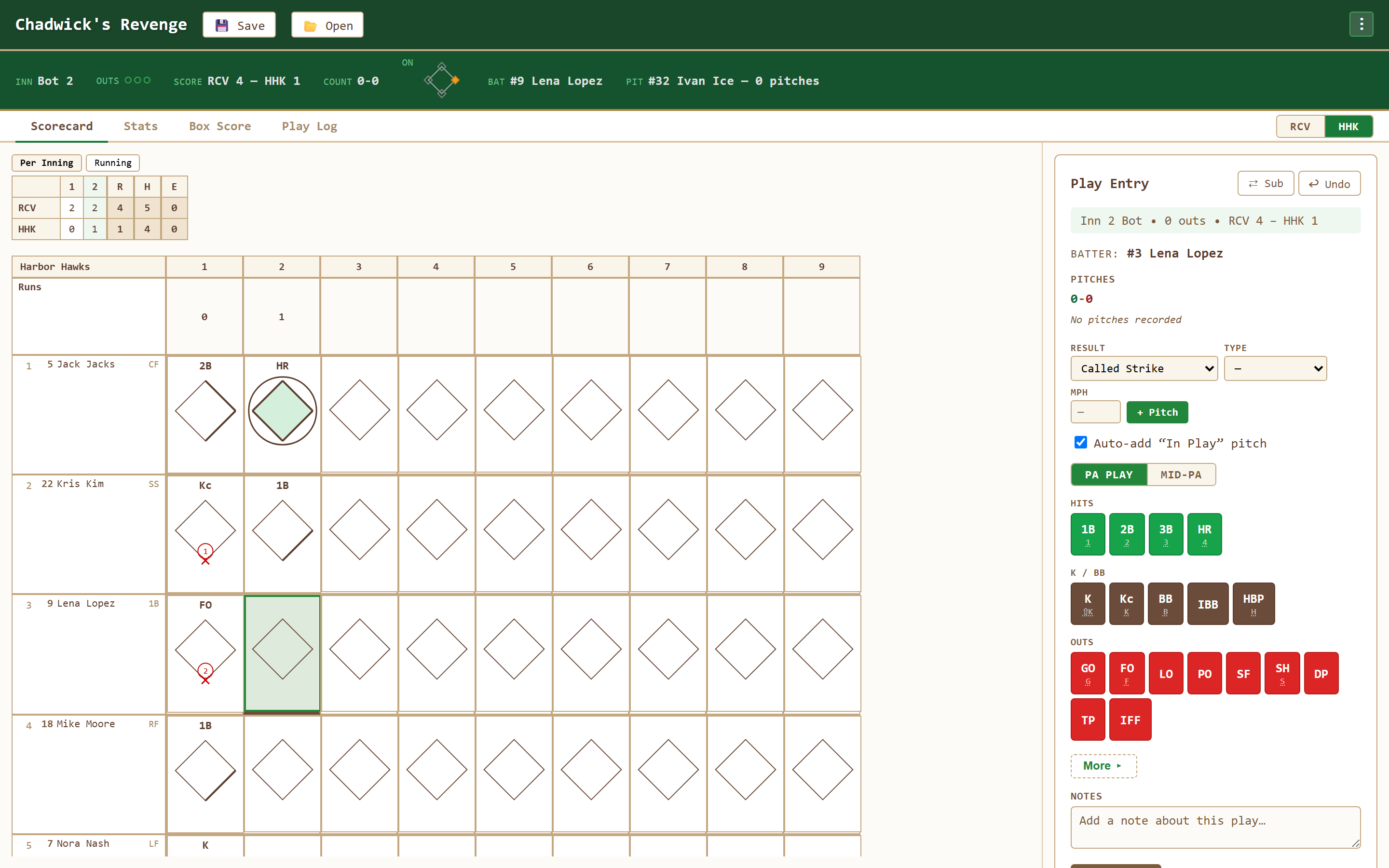
How to read the diamond
Every scorecard cell has a small diamond drawn inside it, matching the actual bases on the field. As a runner advances, the diamond fills in behind them — each base line lights up in order, and a fully filled diamond in solid green means a run scored. This is the visual shorthand every other symbol on this page sits inside:
Want the full walkthrough with a worked example? Read our guide to keeping score in baseball.
Symbol questions
What does a backwards K mean?
It marks a strikeout looking — the batter took a called third strike without swinging. A forward K is a strikeout swinging.
What do the position numbers 1–9 mean?
They're fixed defensive positions: 1 pitcher, 2 catcher, 3 first base, 4 second base, 5 third base, 6 shortstop, 7 left field, 8 center field, 9 right field.
What does E6 mean?
The batter reached on an error by the fielder whose number follows the E — here, the shortstop.
Do I have to memorize all of this?
No. In Chadwick's Revenge, tap what happened on the play and the app writes the correct symbol and runner path for you.
Let the app write the symbols for you
Score a game in Chadwick's Revenge and watch the correct notation appear automatically — free and in your browser.
Open the ScorekeeperWorked examples for the tricky plays
Fielder’s choice: FC is not a hit
Runner on first, no outs. The batter grounds to short; the shortstop throws to second for the force and the batter reaches first. Mark the batter FC, record the runner’s out as 6-4, and leave the batter on first. The batter has an at-bat but no hit. If the relay to first also retires the batter, record the double play and both outs instead.
Sacrifice fly: the out and the run both matter
Runner on third, one out. The batter flies to center, the catch is made, and the runner tags and scores. Mark SF8, record the second out, and complete the runner’s diamond. Credit the batter an RBI and a sacrifice fly, not an at-bat. A fly out with no run scored is simply F8; advancing a runner from second to third alone does not make it a sacrifice fly.
Dropped third strike: a strikeout can still put a runner on
In rules that allow an uncaught-third-strike advance, with first base empty or two outs, the batter may try for first. If a swinging third strike gets away and the batter reaches safely, keep the strikeout and record the advance on WP or PB as appropriate. Do not credit a hit or a walk. If the catcher recovers and throws the batter out at first, record the strikeout and 2-3 putout sequence. Check your division’s rule before allowing the advance; youth and softball variations matter.
Separate the batter’s result from later runner movement
A single followed by a stolen base remains a single. Put 1B in the batter’s cell, draw home-to-first, then extend first-to-second with SB when the steal happens. A later wild pitch is WP, not another hit. Use an error only when your scoring judgment supports it, not whenever a play looks untidy.
A field-side notation cheat sheet
Download the free notation cheat sheet (PDF)
One page of position numbers, common marks, and the decisions behind FC, SF, and an uncaught third strike. Keep it beside a blank scorecard, or use it while learning the editable digital card. No email or account required.
For a full inning walkthrough, use the beginner’s guide; for the complete vocabulary, use the symbols reference.